

What to Know if You're Under Investigation
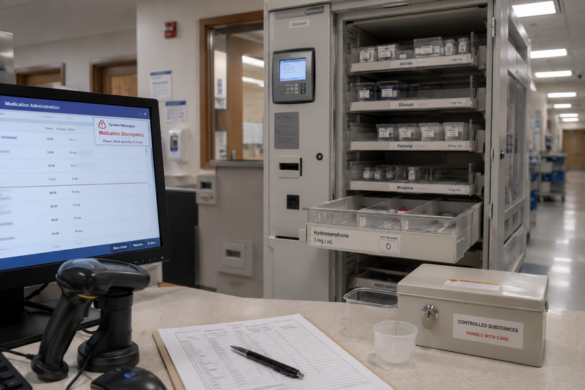
Nurses can face IDFPR discipline for drug diversion when there's evidence of taking medication meant for a patient, falsifying medication administration records, or unusual patterns flagged by automated dispensing systems like Pyxis or Omnicell — even without a criminal charge.
An employer report or an audit flag is often enough to open an investigation.
If you've been questioned about medication discrepancies at work, speak with a defense attorney before you respond.
Call 872-278-4873 or scroll down to start your free consultation!
What Is Considered Drug Diversion in Nursing?
Drug diversion occurs when a controlled substance is used, obtained, or handled in a way that violates healthcare policies or state and federal law.
While some investigations involve allegations of medication theft or personal use, others begin because documentation or medication records do not match what investigators expect to see.
Examples of situations that may lead to diversion allegations include:
- Removing a controlled substance without proper authorization.
- Medication counts that do not reconcile at the end of a shift.
- Failing to properly document or witness wasted medication.
- Inaccurate medication administration records.
- Allegations that medication intended for a patient was used for another purpose.
Not every discrepancy means a diversion occurred.
Busy healthcare environments, communication breakdowns, electronic medication systems, and documentation errors can all contribute to situations that warrant careful, thorough review before conclusions are reached.
What Can Trigger a Drug Diversion Investigation?
Many nurses are surprised to learn that investigations often begin with something relatively small.
A single medication discrepancy may trigger an audit, which can raise additional questions and prompt a broader review of medication records and workplace practices.
Common reasons employers investigate possible drug diversion include:
- Repeated discrepancies involving controlled substances.
- Frequent corrections or inconsistencies in medication documentation.
- Missing or improperly witnessed medication waste.
- Patient complaints involving pain management or medication administration.
- Concerns raised by coworkers or supervisors.
- Irregular medication dispensing patterns identified through automated systems.
Healthcare employers have a responsibility to investigate potential diversion concerns, particularly when controlled substances are involved.
That does not mean every investigation results in disciplinary action, though it does mean the situation should be taken seriously from the beginning.
Can Drug Diversion Cost You Your Nursing License?
It can, although the outcome depends on the facts of the investigation.
State nursing boards evaluate far more than the initial allegation before deciding whether discipline is appropriate.
They may review patient records, medication logs, witness statements, employment history, and any evidence explaining how the discrepancy occurred.
Depending on the circumstances, disciplinary outcomes may include:
- A formal investigation with no disciplinary action.
- Continuing education or additional training.
- License probation or practice restrictions.
- Participation in a monitoring or recovery program.
- License suspension.
- License revocation in the most serious cases.
Every investigation is different.
A medication discrepancy caused by a documentation mistake presents different issues than allegations involving intentional diversion, which is why it is important to understand the facts before responding to investigators.
What Should You Do if You're Accused of Drug Diversion?
Many nurses feel pressured to explain themselves immediately after being questioned by a supervisor or investigator.
While that reaction is understandable, it is important to remember that statements made during an investigation may later become part of the licensing process.
If you are facing allegations involving drug diversion, consider taking these steps:
- Preserve any schedules, medication records, or documentation related to the incident.
- Avoid altering documentation unless you are following established correction procedures.
- Review your employer's reporting and investigation policies.
- Be cautious when discussing the investigation with coworkers.
- Speak with an attorney before providing written statements or responding to a licensing board if your nursing license may be affected.
Can Documentation Errors Be Mistaken for Drug Diversion?
Yes. Documentation mistakes are one of the reasons diversion investigations sometimes begin.
A medication that appears to be missing may ultimately be traced to an incorrect chart entry, a documentation delay, or another administrative issue rather than intentional misconduct.
That does not mean the investigation should be taken lightly.
Employers and licensing boards still have an obligation to determine what happened, and nurses should avoid assuming the issue will resolve itself.
Presenting accurate information early in the process is often an important part of protecting your professional reputation and nursing license.
Protecting Your Nursing License During a Drug Diversion Investigation
An allegation of drug diversion can affect far more than your current job.
Depending on the circumstances, it may lead to employer discipline, licensing board investigations, and even criminal inquiries.
Responding strategically from the beginning can make a meaningful difference in how your case develops.
Callahan Law represents nurses facing drug diversion allegations, controlled substance investigations, medication documentation issues, and other professional licensing matters throughout Illinois, Indiana, Michigan, Missouri, and Wisconsin.
Our team understands what is at stake and works closely with healthcare professionals to protect their licenses, their reputations, and the careers they have worked hard to build.
If you have been accused of drug diversion or are responding to a nursing board investigation, contact Callahan Law to discuss your situation.
Call 872-278-4873 or scroll down to start your free consultation!.
We can help you understand the process, evaluate your options, and build a strategy to protect your nursing license and your future.